Diagnosis is the most important part of the work.
We don't measure to fill in a form. We measure to understand the real behaviour of the acoustic problem. The difference between the two approaches defines the quality of the solution.
Understanding the problem before solving anything.
Sound does not behave uniformly. Every environment has a specific acoustic response that depends on its geometry, materials, noise sources and the paths through which sound energy is transmitted — both through the air and through the structure.
A rigorous acoustic diagnosis is not limited to measuring levels in decibels. It involves analysing the sound field by frequency, identifying sources precisely and quantifying their relative contribution, analysing transmission mechanisms — airborne, impact, structural — and building a model of the system's behaviour.
At SNA, diagnosis is the most demanding technical work and the one with the greatest impact on the final result.
Advanced diagnostic tools.
Precision acoustic measurement
Class 1 sound level meters, real-time spectrum analysers, multi-channel measurement systems. Measurements are performed in accordance with UNE and ISO standards applicable to each context.
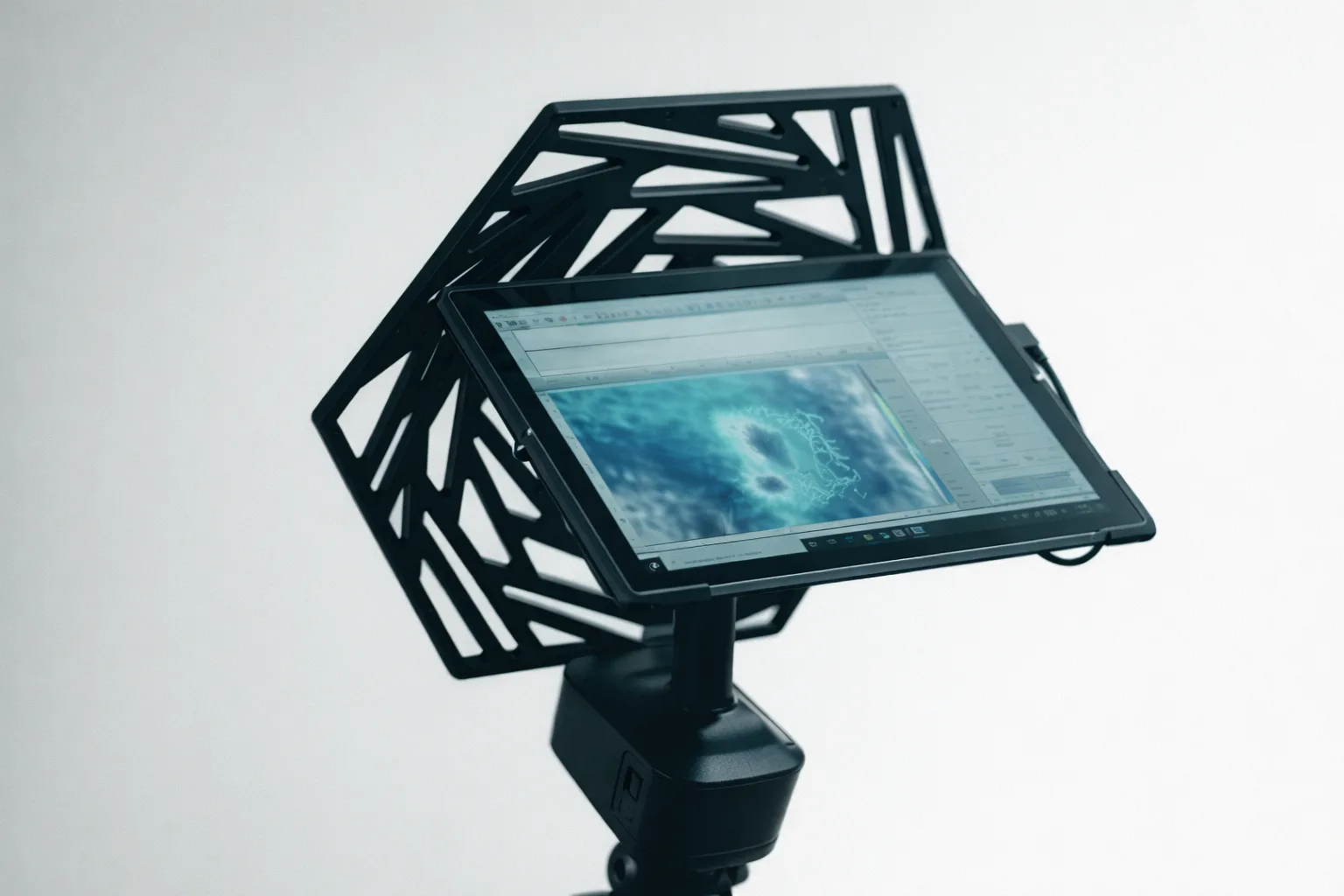
Acoustic camera (beamforming)
The acoustic camera allows visualising and locating noise sources with spatial precision. Particularly useful in complex industrial environments where multiple sources coexist.
Sound spectrum analysis
Frequency analysis is fundamental for diagnosis. Low, mid and high frequencies have different physical behaviours and require different solutions.
Vibration measurement
Structural vibrations often constitute the most critical and complex noise transmission path. Their proper characterisation is essential in diagnosing both industrial and building projects.
Noise maps
In environmental and urban planning projects, we produce noise maps representing the spatial distribution of sound levels in the studied environment.
Regulations as context, not as a limit.
Acoustic diagnosis always operates within a regulatory framework: Royal Decree 286/2006 in occupational settings, the Technical Building Code (DB-HR) in construction, Royal Decree 1367/2007 on environmental matters, and Law 37/2003 on Noise.
Knowing and correctly applying regulations is the minimum requirement. Our diagnosis goes further: it identifies the real problems behind the regulatory indicators.